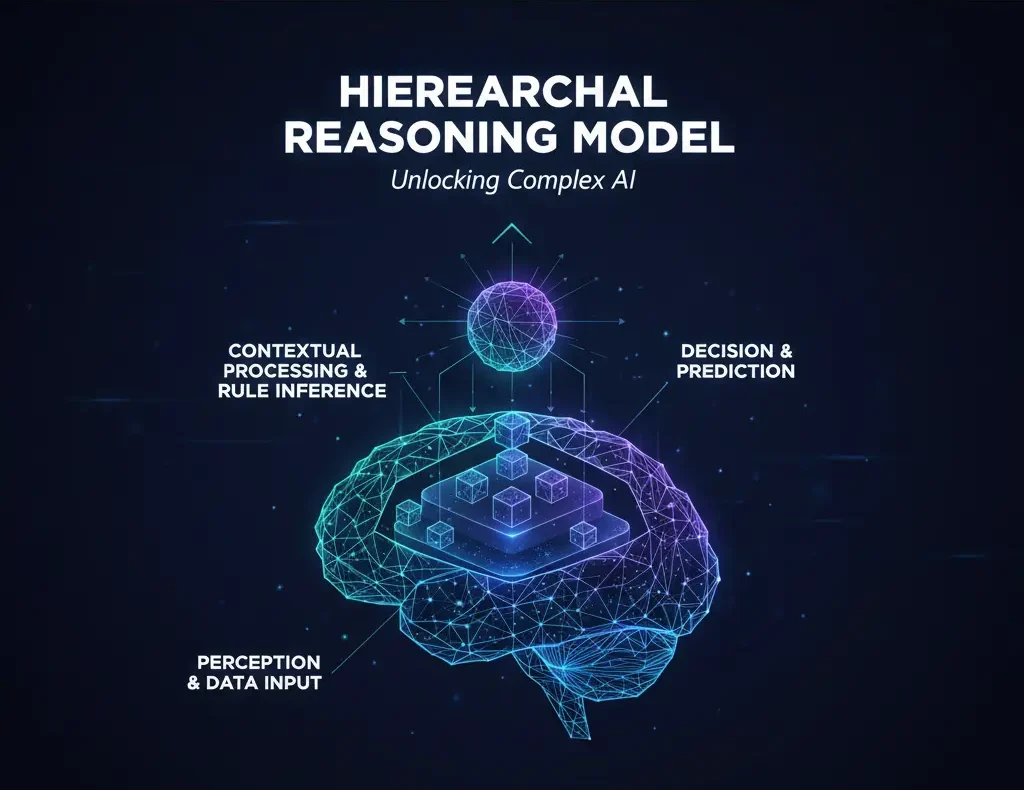
Artificial intelligence is evolving rapidly, and one of the most important breakthroughs shaping modern AI systems is the Hierarchical Reasoning Model. This approach helps machines think, plan, and solve problems in a structured way—similar to how humans break down complex tasks into smaller, manageable steps.
As AI becomes more involved in decision-making, research, and everyday applications, hierarchical reasoning is emerging as a foundation for smarter and more reliable systems.
What Is a Hierarchical Reasoning Model?
Hierarchical Reasoning Model (HRM) is an artificial intelligence model in which the reasoning process consists of several levels. The model does not process everything simultaneously; instead, thinking is divided into layers, i.e., high-level goals and low-level actions.
At the highest level, the model addresses large-scale goals, such as understanding a user’s intent or formulating a strategy. On lower levels, it also involves detailed reasoning, such as calculations, rules, or step-by-step execution. This stratification structure enables AI systems to handle complexities in a better way.
Why Hierarchical Reasoning Matters in AI
Traditional AI models often struggle with long-term planning and multi-step logic. Hierarchical reasoning addresses this limitation by enabling structured thinking. Key benefits include:
- Improved problem-solving accuracy
- Better handling of complex, multi-step tasks
- Reduced errors caused by overwhelming information
- More human-like reasoning behavior
By dividing tasks into logical levels, AI can reason more clearly and adapt its approach when conditions change.
How Hierarchical Reasoning Works
Hierarchical reasoning typically involves three main layers:
- High-Level Planning
This layer defines the goal and overall strategy. For example, deciding what needs to be done rather than how. - Mid-Level Reasoning
Here, the model breaks the goal into sub-tasks, selecting appropriate methods or rules. - Low-Level Execution
This layer performs concrete actions, calculations, or responses based on instructions from higher levels.
This structure mirrors human thinking—first deciding on a goal, then planning steps, and finally executing actions.
Real-World Applications of Hierarchical Reasoning Models
Hierarchical reasoning is already influencing multiple industries:
- Artificial Intelligence Assistants: Enable better task planning and contextual understanding.
- Robotics: Helps robots plan movements while adapting to real-world environments.
- Healthcare AI: Supports diagnostic reasoning by combining high-level analysis with detailed medical data.
- Autonomous Vehicles: Allow vehicles to plan routes while responding to immediate road conditions.
- Scientific Research: Assists in hypothesis generation and structured problem-solving.
Hierarchical Reasoning and the Future of AI
Hierarchical reasoning is becoming an important aspect in safety, transparency, and reliability as AI models continue to grow in size and capability. It enables the AI systems to be more explanatory of their decisions as well as minimizing unpredictable behavior.
Hierarchical reasoning will be combined with deep learning, reinforcement learning, and memory-based systems in the future to produce AI that is capable of reasoning, planning, and learning in a more efficient manner as time goes by.
Final Thoughts
The Hierarchical Reasoning Model is one of the significant advances of more intelligent and more human-like AI systems. Because it breaks down an idea into levels, it allows machines to approach sophisticated issues in an unambiguous and meaningful way.
With the rise in AI as a part of everyday existence, hierarchical reasoning will be central to making technology smarter, safer, and more compatible with human reasoning.